
GRIDLOCK: POWERING ARTIFICIAL INTELLIGENCE IN ALIGNMENT WITH OR IN DEFIANCE OF AFRICA’S ENERGY REALITY
An artificial intelligence energy nexus is emerging across the continent

BY CHERYL-ANNE SMITH[1]
Summary: Artificial intelligence (AI) infrastructure, particularly data centres, is fuelling a sharp rise in global demand for critical rare earth minerals, water, and electricity, including outpacing the growth of new power generation systems. Nowhere is this pressure more visible than in Africa, where the expansion of AI-driven data centres is putting additional strain on already limited energy systems. This trend signals a growing AI energy nexus emerging across the continent, where power-hungry data centres are being prioritised over improving public services, even as Africa’s costly energy deficit remains unresolved. Now the continent stands at a strategic crossroads, whether to build AI-driven data centres in alignment with or in defiance of its energy reality.
Available for institutional reuse and purchase as a downloadable PDF at:

The artificial intelligence energy nexus
Global artificial intelligence (AI) spending in 2026 is projected to exceed US$2 trillion, driven by the rapid expansion of AI factories and data centres, alongside the rising demand for high-performance chips and AI applications. Yet at the centre of this growth sits the AI energy nexus, a complex web that links AI’s consumption of electricity, water and critical rare minerals with the ecosystems and communities that depend on those very same resources.[2]
A spill-over effect is unavoidable as pressures in one domain inevitably affect other areas. According to the International Energy Agency (IEA), in 2026, generative AI and machine learning systems are expected to consume large amounts of energy, potentially up to ten times more than conventional searches would, while global electricity consumption from data centres is projected to exceed 800 terawatt hours (TWh).[3] As a result, the electricity demand will sharply increase, power grids will face severe strain, and emissions will accelerate. Water diverted for cooling these facilities will reduce the supply available for agriculture or household consumption, while the extraction of critical rare earth minerals for AI infrastructure risks displacing communities and degrading biodiversity.[4]
AI investors are not concerned with these wider consequences; their top priority is securing enough energy to keep AI systems functioning. Power availability has become a major factor and a defining challenge for digital infrastructure investors and data centre developers. Electricity grids have not expanded fast enough and have already fallen behind the rising demand created by AI, cloud services and the digitalisation of public services. As such, reliable and affordable electricity has become the new AI arms race, and in this urgent race, the real winner is the one who can generate significant amounts of power to keep AI running.[5]

Understanding Africa’s energy landscape in the age of artificial intelligence
In Africa, fossil fuels account for 77% of the continent’s energy mix, with a heavy dependence on imported fuels, despite vast renewable energy potential.[6]Traditional power stations have aged, while expansions have been slow and costly. As a result, approximately 640 million people on the continent still lack dependable electricity, especially in rural areas where communities remain underserved. Those who can afford electricity experience high costs and regular blackouts.[7]In addition, Africa’s average per capita energy consumption stands at 180 kilowatt-hours (KWH), in stark contrast to the 13,000 KWH used in the United States (US) and 6,500 KWH used in Europe.[8]
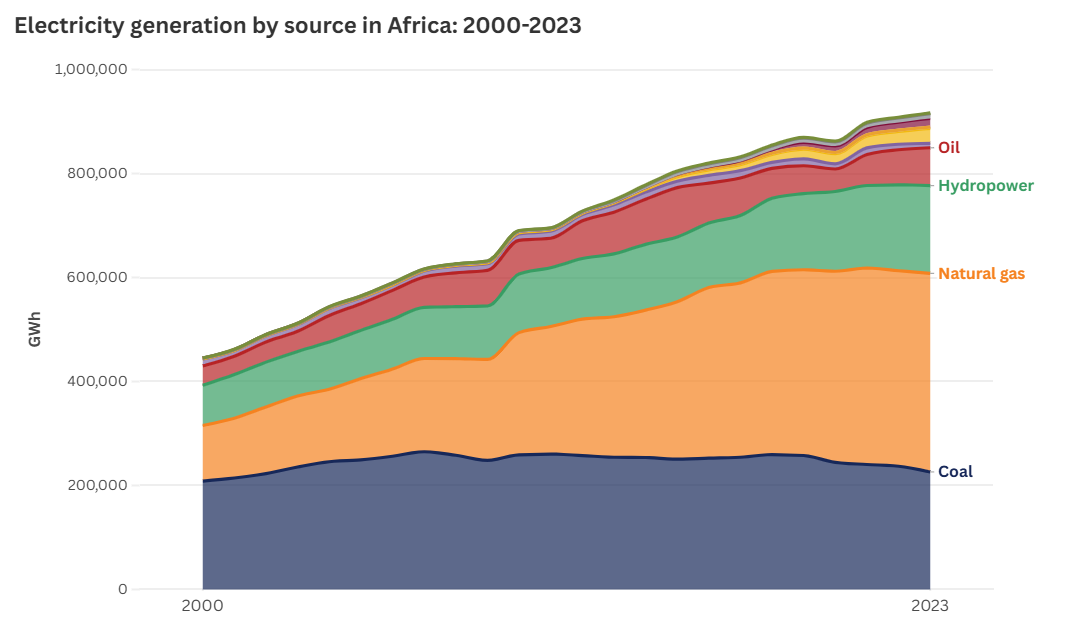
Image Courtesy of: Institute for Security Studies| African Futures with AUDA-NEPAD[9]
As the demand for digital services continues to rise across the continent, access to reliable electricity remains constrained. AI adds additional pressure to the continent’s limited power generation capacity. For example, at present, 39 African countries house at least one data centre, which collectively represent less than 1% of the global data centre capacity. However, according to the Africa Data Centres Association, the continent aims to create a digital inclusive future for its citizens by building 700 new data centre facilities, which will require at least 1,000 megawatts of additional power. [10]
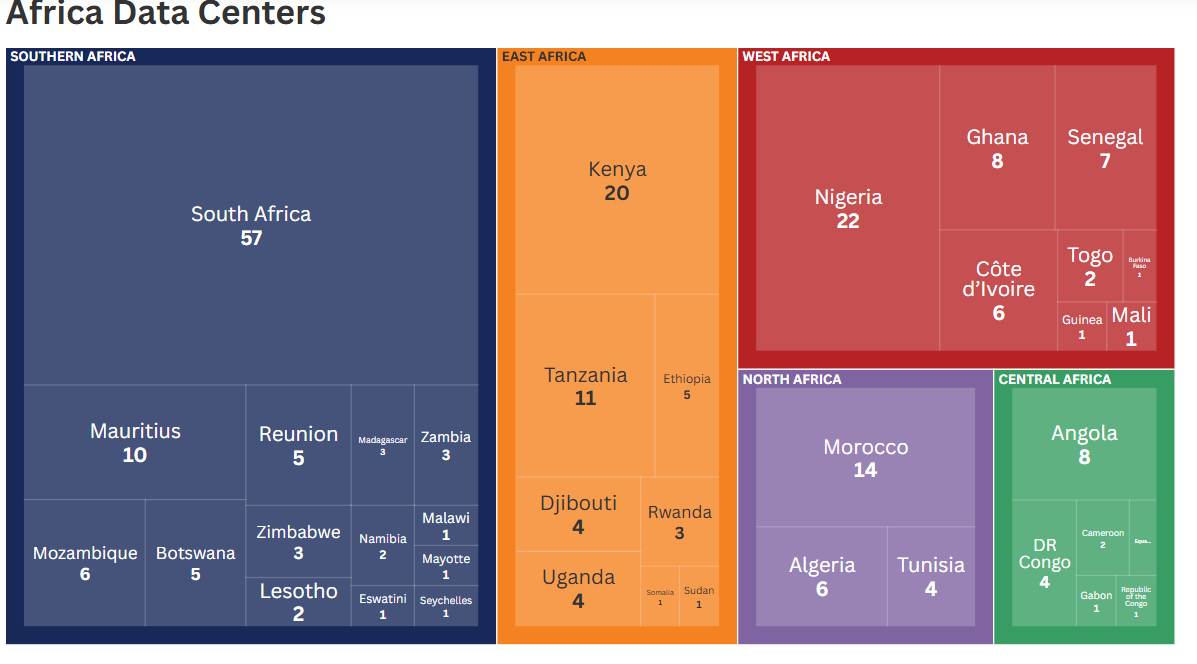
Image Courtesy of: Institute for Security Studies| African Futures with AUDA-NEPAD[11]
This trend signals a growing AI energy nexus emerging across the continent, where data centres are being prioritised over improving basic services, even as Africa’s costly energy deficit remains unresolved. The consequences are already visible. Many citizens who reside close to these data facilities complain about water reserves being depleted, noise pollution, local electricity prices spiking, and blackouts occurring more frequently. Furthermore, limited electricity access continues to hinder economic growth, restrict social development and delay progress toward the African Union’s 2063 goal of universal, affordable and sustainable energy for all Africans.[12]
Now the continent finds itself at a strategic crossroads, forced to navigate the growing tension between its energy reality and the escalating power demands of AI-driven data centres. The question is no longer about whether to build data centres, but how. Will Africa choose to build AI-driven data centres in alignment with its energy reality, or will it pursue an imbalanced path where AI facilities flourish while millions remain in the dark?[13]
Building data centres in alignment with or in defiance of Africa’s energy reality
Energy Alignment: When AI-driven data centres are built in alignment with Africa’s energy reality, then AI becomes a tool for advancing energy justice rather than competing for scarce resources, especially when powered by renewables. East Africa is a prime example where data centres are increasingly being powered with strong solar and geothermal resources.[14]These facilities are built with the intention of strengthening national power grids rather than weakening them, with data centre operators investing in new powerlines and substations to reduce their dependence on fragile local power grids.[15] And when AI is used to improve energy planning and grid efficiency, as envisioned by the African Union’s (AU) Continental AI Strategy, it supports equitable adoption grounded in local needs, not global hype.[16]
Energy Defiance: By rapidly advancing AI facilities in pursuit of digital prestige without first addressing the continent’s energy limitations, African governments risk exacerbating existing inequalities, most notably the widespread energy poverty affecting their citizens. Prioritising power-hungry AI-driven data centres will inevitably divert electricity away from the needs of communities and further destabilise national power grids.[17] Moreover, this could result in an energy caste system where AI-driven data centres enjoy resilient power, while households endure rolling blackouts, rising electricity and water costs, water shortages and environmental degradation, especially in drought-prone regions.[18]
Power artificial intelligence responsibly across the continent
Africa’s energy reality is fundamentally different from that of the US and Europe, which means that it cannot advance its AI-driven data centre ambitions without strong energy governance. Without it, the social and economic consequences for its citizens will be severe. To ensure AI contributes positively to Africa’s energy future, AI expansion must follow a balanced approach, one that aligns with the AU’s developmental priorities and reflects the continent’s actual energy reality. Moreover, its AI ambitions should be guided not by speed but by the wisdom and foresight of its energy decisions.
IF YOU VALUE THIS RESEARCH!!!! CLICK THE JAR BELOW!!!!!!

YOUR DONATIONS DIRECTLY SUPPORT INDEPENDENT THOUGHT LEADERSHIP, FUTURE RESEARCH, CONTENT CREATION, AND ADVOCACY UNDER THE POLICY SHIFTS PLATFORM. THANK YOU FOR YOUR SUPPORT!!!
[1] CHERYL-ANNE SMITH is the Founder of Policy Shifts. She has worked within the Information and Technology Services Industry, occupying positions in Strategic Intelligence and Management Consultancy. Her portfolio of work can be accessed via Linktree: https://linktr.ee/cheryl007 or LinkedIn: https://www.linkedin.com/in/cheryl-anne-smith-007796252/. Contact CHERYL-ANNE SMITH at annecheryl@proton.me
[2] Lauren Smart and Sam Hsu, “The AI-energy nexus will determine AI’s impact. We must account for it better,” World Economic Forum, December 1, 2025, https://www.weforum.org/stories/2025/12/ai-energy-nexus-ai-future/
[3] “Powering Africa’s Digital Future: The Challenge of Energy for Data Centre Development,” Bracewell, April 16, 2025, https://www.bracewell.com/resources/powering-africas-digital-future-the-challenge-of-energy-for-data-center-development/#
[4] Lauren Smart and Sam Hsu, “The AI-energy nexus will determine AI’s impact. We must account for it better,” World Economic Forum, December 1, 2025, https://www.weforum.org/stories/2025/12/ai-energy-nexus-ai-future/
[5] “Powering Africa’s Digital Future: The Challenge of Energy for Data Centre Development,” Bracewell, April 16, 2025, https://www.bracewell.com/resources/powering-africas-digital-future-the-challenge-of-energy-for-data-center-development/#
[6] Dr Tamuka Chekero and Phatsimo Rahman, “Harnessing Artificial Intelligence (AI) to Propel a Just Energy Transition in Africa,” OJTA, February 21, 2025, 2 https://southsouthnorth.org/wp-content/uploads/2025/02/OJTA-Policy-Brief-HARNESSING-AI-FOR-JUST-ENERGY-TRANSITION-IN-AFRICA.pdf
[7] “Powering Africa’s Digital Future: The Challenge of Energy for Data Centre Development,” Bracewell, April 16, 2025, https://www.bracewell.com/resources/powering-africas-digital-future-the-challenge-of-energy-for-data-center-development/#
[8] Dr Tamuka Chekero and Phatsimo Rahman, “Harnessing Artificial Intelligence (AI) to Propel a Just Energy Transition in Africa,” OJTA, February 21, 2025, 2 https://southsouthnorth.org/wp-content/uploads/2025/02/OJTA-Policy-Brief-HARNESSING-AI-FOR-JUST-ENERGY-TRANSITION-IN-AFRICA.pdf
[9] Kyle Volpi Hierbert, “Data centre investments are a gamble for Africa,” ISS Africa Futures with AUDA-NEPAD, December 4, 2025, https://futures.issafrica.org/blog/2025/Data-centre-investments-are-a-gamble-for-Africa#
[10] “Powering Africa’s Digital Future: The Challenge of Energy for Data Centre Development,” Bracewell, April 16, 2025, https://www.bracewell.com/resources/powering-africas-digital-future-the-challenge-of-energy-for-data-center-development/#; Kyle Volpi Hierbert, “Data centre investments are a gamble for Africa,” ISS Africa Futures with AUDA-NEPAD, December 4, 2025, https://futures.issafrica.org/blog/2025/Data-centre-investments-are-a-gamble-for-Africa#
[11] Kyle Volpi Hierbert, “Data centre investments are a gamble for Africa,” ISS Africa Futures with AUDA-NEPAD, December 4, 2025, https://futures.issafrica.org/blog/2025/Data-centre-investments-are-a-gamble-for-Africa#
[12] Dr Tamuka Chekero and Phatsimo Rahman, “Harnessing Artificial Intelligence (AI) to Propel a Just Energy Transition in Africa,” OJTA, February 21, 2025, 2 https://southsouthnorth.org/wp-content/uploads/2025/02/OJTA-Policy-Brief-HARNESSING-AI-FOR-JUST-ENERGY-TRANSITION-IN-AFRICA.pdf
[13] Paul Colmer, “Opinion: The AI data centre conundrum for South Africa’s power future,” Energize, November 4, 2025, https://www.energize.co.za/article/opinion-the-ai-data-centre-conundrum-for-south-africas-power-future#
[14] “Africa’s Data Centre Boom Reshapes Energy and Digital Infrastructure Landscape,” Asian-African Chamber of Commerce & Industry, December 26, 2025, https://asianafrican.org/africas-data-centre-boom-reshapes-energy-and-digital-infrastructure-landscape/
[15] Ben Payton, “Inside the race to fire up Africa’s power-hungry data centres,” African Business, December 23, 2025, https://ohlins.african.business/2025/12/energy-resources/inside-the-race-to-fire-up-africas-power-hungry-data-centres
[16] Ben Selier, “Africa’s pragmatic approach to AI and how data centres are enabling it,” IT Industry News Daily, July 9, 2025, https://it-online.co.za/2025/07/09/africas-pragmatic-approach-to-ai-and-how-data-centres-are-enabling-it/; Kyle Volpi Hierbert, “Data centre investments are a gamble for Africa,” ISS Africa Futures with AUDA-NEPAD, December 4, 2025, https://futures.issafrica.org/blog/2025/Data-centre-investments-are-a-gamble-for-Africa#; Paul Colmer, “Opinion: The AI data centre conundrum for South Africa’s power future,” Energize, November 4, 2025, https://www.energize.co.za/article/opinion-the-ai-data-centre-conundrum-for-south-africas-power-future#
[17] Robert Mutahi, “ Power for People or Power for Machines? The Ethical Crossroads of Africa’s AI Future,” LinkedIn, December 4, 2025, https://www.linkedin.com/pulse/power-people-machines-ethical-crossroads-africas-ai-future-mutahi-xsaef/
[18]Robert Mutahi, “ Power for People or Power for Machines? The Ethical Crossroads of Africa’s AI Future,” LinkedIn, December 4, 2025, https://www.linkedin.com/pulse/power-people-machines-ethical-crossroads-africas-ai-future-mutahi-xsaef/; Ben Payton, “Inside the race to fire up Africa’s power-hungry data centres,” African Business, December 23, 2025, https://ohlins.african.business/2025/12/energy-resources/inside-the-race-to-fire-up-africas-power-hungry-data-centres; Kyle Volpi Hierbert, “Data centre investments are a gamble for Africa,” ISS Africa Futures with AUDA-NEPAD, December 4, 2025, https://futures.issafrica.org/blog/2025/Data-centre-investments-are-a-gamble-for-Africa#
Get more from Policy Shifts on Patreon https://www.patreon.com/c/PolicyShifts. Reach out to Cheryl-Anne via the contact form here: https://docs.google.com/forms/d/e/1FAIpQLSdCAJxOvw3fHj0jVmJYIDIkcicQoMF8vEumfK0YR9YmUybl2w/viewform?edit_requested=true
For information about sponsoring a Policy Shifts Post, click the link: https://www.patreon.com/posts/sponsor-policy-146905596