
AFRICA'S ARTIFICIAL INTELLIGENCE POLICY RESPONSE IN A WORLD DOMINATED BY BIG TECH
Artificial Intelligence in Africa


BY CHERYL-ANNE SMITH[1]
Summary: By 2030, the global AI economy is projected to surpass US$1 trillion, yet Africa’s share of this growth remains minimal. The continent's digital landscape is increasingly shaped by Chinese AI infrastructure, raising serious concerns around governance, sovereignty, prosperity, and autonomy. Despite the release of the African Union's Continental AI Strategy in 2024, most African countries have yet to finalize their national AI strategies. In contrast, early adopters, namely, Mauritius, Egypt, and Rwanda, demonstrated strategic foresight by launching their strategies ahead of the AU’s blueprint as they recognised the urgency of artificial intelligence’s transformative impact across government, business, and society.

Africa’s governance gap and limited stake in a trillion-dollar AI economy
Artificial intelligence (AI) is not only a global policy priority, but it is also actively reshaping governance frameworks worldwide, and Africa is no exception. By 2030, AI is projected to contribute US$15.7 trillion to the global economy. However, foreign technology and AI firms still dominate the African landscape, limiting the continent's ability to capture a meaningful share of AI-driven economic growth. As a result, Africa continues to attract less than 2 percent of global AI investment, despite having the world’s youngest population. This imbalance raises serious governance concerns about AI technologies being developed abroad with far fewer benefits for local communities and the uneven distribution of wealth and power, particularly as AI technologies remain largely concentrated in the hands of large technology companies.[2]
China, in particular, has emerged as the dominant exporter of AI technologies across the African continent through its broader macroeconomic foreign policies, notably the Belt and Road Initiative and Beijing's Digital Silk Road Initiative. These policies have enabled the widespread deployment of Chinese digital infrastructure across the continent. Around 40 out of the 54 African countries have entered into these agreements, resulting in the rollout of smart city infrastructure, cloud computing, e-commerce networks, 5G connectivity, and surveillance technologies in numerous African cities.[3]
The African Unions' Continental AI strategy for Africa’s development and prosperity
To drive momentum and support the creation of national AI strategies across the continent, the African Union (AU) released its Continental AI strategy in 2024. This framework aims to harness AI as a driver of Africa’s development, innovation, and long-term prosperity. By promoting a people-centred, inclusive approach aligned with Agenda 2063, it signals a unified continental vision to shape AI on African terms, promote digital sovereignty, and ensure that emerging technologies serve inclusive growth and ethical governance.[4]
Five key areas are outlined, notably 1) Leveraging AI to improve people's livelihoods in agriculture, education, healthcare, public service delivery, climate change, peace, and security, and enhance private sector competitiveness; 2) Addressing risks tied to AI adoption with particular attention to areas such as human rights, gender equality, inclusion, etc; 3) Strengthening infrastructure across member states; 4) Fostering regional and global partnerships to build AI capacity and elevate Africa’s global influence and; 5) Encouraging public and private investments in AI at both national and regional levels.[5]

The rise and absence of artificial intelligence strategies across Africa
As of July 2025, only 16 out of 54 African countries have launched their national AI strategies. Early adopters include Mauritius, Egypt, and Rwanda, followed by Kenya, Nigeria, Ghana, Algeria, Senegal, Benin, Ethiopia, Lesotho, Cameroon, Cote d’Ivoire, Mauritania, Zambia, and Namibia. Meanwhile, 34 countries are either in the process of drafting or actively developing their AI strategies, while four have yet to initiate the process.[6]
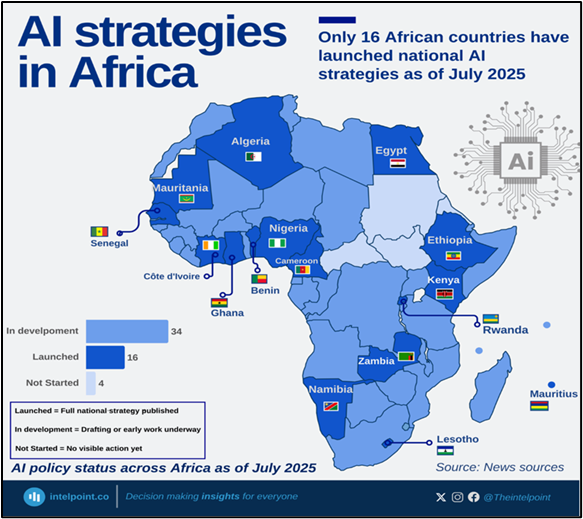
Image Courtesy of Intelpoint[7]
Prior to the AU launching the Continental AI Strategy, Mauritius, Egypt, and Rwanda had already demonstrated strategic foresight by releasing their own individual national AI frameworks. By taking such a proactive stance, these countries positioned themselves as digital leaders in Africa, setting distinct AI pathways that would advance both their national interests and the well-being of their citizens within the global AI landscape.[8]
1) Mauritius
Mauritius led the way as Africa’s frontrunner by launching the Digital Mauritius plan in 2018.[9] This strategic framework aims to transform the country into a ‘smart island’ by 2030[10], leveraging technologies such as AI, cloud computing, blockchain, data, and connectivity to foster inclusive digital transformation. The framework is built around strengths such as a supportive policy environment, strong cybersecurity foundations, an open-source culture, and widespread free internet access, while recognising challenges like limited resources and funding, fragmented data systems, security risks, and legal barriers.[11]
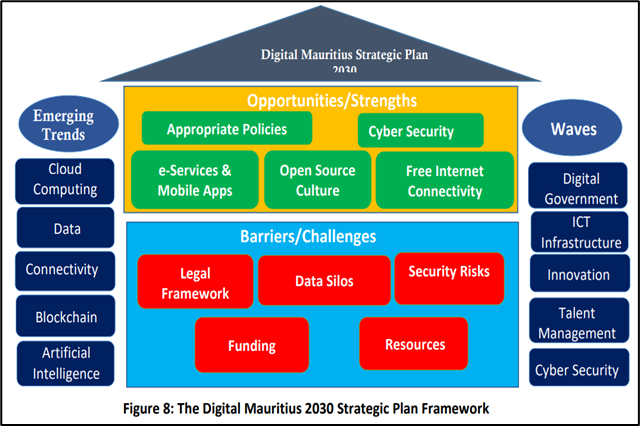
Image Courtesy of Digital Mauritius 2030[12]
The strategy focuses on five areas or ‘waves’ notably 1) Digital government whereby public service delivery is enhanced through AI and automation; 2)Expanding information and communication technology (ICT) infrastructure, digital connectivity and computing capacity; 3) Promoting innovation through supporting technology-driven entrepreneurship and research; 4)Developing talent by building digital skills and AI literacy and; 5) Ensuring cybersecurity for safe and resilient digital ecosystems.[13]
In addition, the strategy also extends to the ocean economy, where AI will be deployed for smart ports and traffic management, as well as energy management systems designed to reduce carbon emissions. Central to Mauritius' approach is a strong emphasis on collaboration with private and public sector institutions.[14]Moreover, the strategy includes measures for skills development, allocating funding for research and development, as well as the establishment of governance structures such as data protection policies, open data platforms, and an AI ethics committee to ensure the responsible and transparent use of AI.[15]
2) Egypt
In 2020, Egypt followed suit and introduced its first national AI strategy. An updated second edition has since been released in 2025, reflecting a renewed vision to align with the country's shifting national priorities. This revised strategy aims to ensure that AI adoption supports Egypt's developmental goals, responds to global trends, and builds on local capacities.[16]
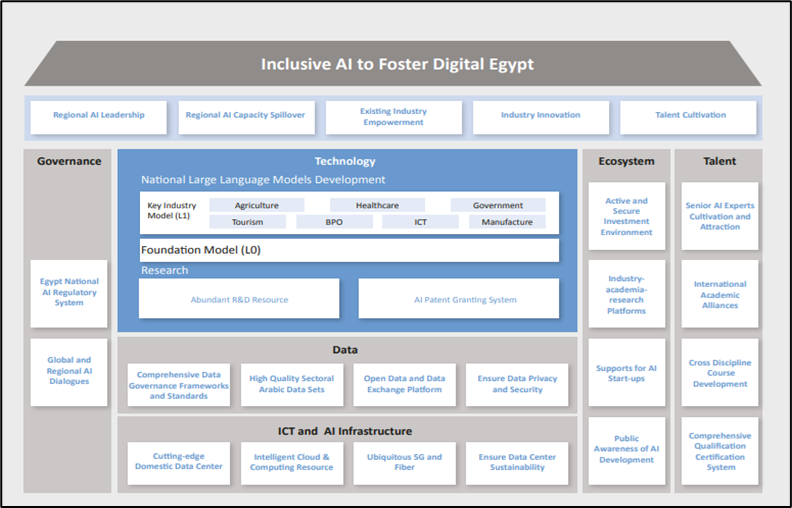
Image Courtesy of Egypt National Artificial Intelligence Strategy, Second Edition 2025-2030[17]
It is structured around six pillars to achieve key strategic objectives and goals, notably,1) Governance that develops national AI regulations and enhances Egypt’s influence in global and regional AI forums; 2)Technology that advances large scale AI models and patents across a range of sector specific industries such as agriculture, healthcare, tourism, etc; 3) Creating a stable and secure ecosystem for investment and fostering collaboration between industry and academia, including supporting AI startups while raising public awareness regarding the development of AI; 4) Naturing talent, in particular, senior AI experts and building international academic alliances as well as promoting interdisciplinary education and certification; 5) Establishing strong data governance by creating high quality Arabic datasets and ensuring open access, privacy and security and; 6) Investing in information and communication technologies (ICT) and AI Infrastructure such as advanced data centers, intelligent cloud computing, widespread 5G and fibre networks and sustainable digital infrastructure.[18]
3) Rwanda
Rwanda unveiled its national AI strategy in 2022 with a bold ambition to become Africa’s leading hub for AI research and innovation. Its strategy outlines a clear vision to harness AI as a driver of economic growth, improved quality of life, and global leadership in the development of responsible and inclusive AI solutions.[19] Six key priority areas have been outlined to accelerate the responsible development and deployment of AI across the country. These areas are grouped according to three categories, namely 1) Enablers: which focus on building 21st-century skills, enhancing AI literacy, strengthening infrastructure, and computing capacity, and developing a robust data strategy. 2) Accelerators: which promote the adoption of trustworthy AI in the public sector and encourage inclusive AI in the private sector. 3) Safeguards: that emphasize the implementation of practical ethical guidelines to ensure responsible governance.[20]
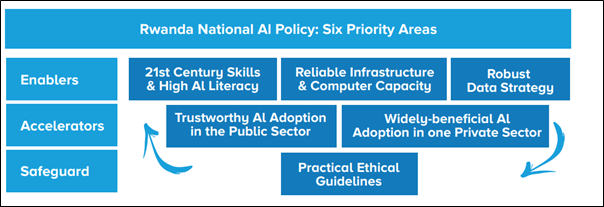
Image Courtesy of the Republic of Rwanda, The National AI Policy[21]
Strategic lessons from early African nations in building ethical AI governance frameworks
Although the AU’s Continental AI strategy provides a blueprint for other African countries still in the process of developing their AI strategies.[22] Strategic lessons can be drawn from early adopters, namely, Mauritius, Egypt, and Rwanda.[23] First and foremost, rather than waiting for direction and guidance from the AU, Mauritius, Egypt, and Rwanda acted with urgency and foresight. These African nations recognised early on that emerging technologies such as artificial intelligence would become an integral part of everyday life and ultimately revolutionise every sector, from government public services, business operations, to the way people live and interact.[24]
Rather than adopting foreign technology policy models, Mauritius, Egypt, and Rwanda crafted their strategies by prioritising localised AI governance that reflects their own unique cultural, social, economic, and political realities. Their focus on inclusive infrastructure and expanded access to digital systems aims to bridge the digital divide, particularly for underserved and historically disadvantaged communities.[25]
Similarly, they have incorporated ethical governance mechanisms into their AI frameworks to ensure that these technologies serve to empower their citizens and not exploit them. By taking a citizen-first approach, such as investing in locally led innovation ecosystems to strengthen local capacities, Mauritius, Egypt, and Rwanda’s AI strategies signal a counterbalance to the dominant Chinese digital infrastructure across the continent. Their strategies reframe AI as a technology that can be used for development and industrial innovation in sectors such as agriculture, healthcare, manufacturing, peacebuilding, and security etc; instead of relinquishing control of these industries to a dominant foreign power that deploys AI for major influence, surveillance, and or manipulation.[26]
Moreover, it reflects their deepening commitment to digital sovereignty, ethical innovation, and inclusive development, ensuring that AI serves Africa’s competitiveness, autonomy, and public good.[27]
Artificial intelligence strategies must be rooted in African realities
African nations that have yet to launch their AI strategies can no longer justify their inaction. With the AU offering a clear continental blueprint, and 16 African countries already having paved the way with their unique national strategies, the tools, models, and momentum are in place. It is time for the rest of the continent to move from deliberation to decisive action and craft their AI policies that reflect local realities, protect their citizens' rights, and position Africa as a global leader in ethical and inclusive innovation.
Available for institutional reuse and purchase as a downloadable PDF at:
IF YOU VALUE THIS RESEARCH!!!! CLICK THE JAR BELOW!!!!!!

YOUR DONATIONS DIRECTLY SUPPORT INDEPENDENT THOUGHT LEADERSHIP, FUTURE RESEARCH, CONTENT CREATION, AND ADVOCACY UNDER THE POLICY SHIFTS PLATFORM. THANK YOU FOR YOUR SUPPORT!!!
[1] CHERYL-ANNE SMITH is the Founder of Policy Shifts. She has worked within the Information and Technology Services Industry, occupying positions in Strategic Intelligence and Management Consultancy. Her portfolio of work can be accessed via Linktree: https://linktr.ee/cheryl007 or LinkedIn: https://www.linkedin.com/in/cheryl-anne-smith-007796252/. Contact CHERYL-ANNE SMITH at annecheryl@proton.me
[2] Dr Rachel Adams, “AI in Africa: Key Concerns and Policy Considerations for The Future of The Continent,” Africa Policy Research Institute, April 2022, 2, https://afripoli.org/uploads/publications/AI_in_Africa.pdf; Aubra Anthony, Jane Munga and Sharmista Appaya, “From the margins to the centre: Africa’s role in shaping AI governance,” World Bank Blogs, November 8, 2024, https://blogs.worldbank.org/en/governance/from-the-margins-to-the-center--africa-s-role-in-shaping-ai-gove#; “Africa’s AI market to be the next growth frontier for global tech players,” CNBC Africa, June 18, 2025, https://www.cnbcafrica.com/media/7750240731437/africas-ai-market-to-be-the-next-growth-frontier-for-global-tech-players/
[3]Dr Rachel Adams, “AI in Africa: Key Concerns and Policy Considerations for the Future of the Continent,” Africa Policy Research Institute, April 2022, 7, https://afripoli.org/uploads/publications/AI_in_Africa.pdf; Joseph Tinarwo and Suresh Chandra Babu, “Chinese artificial intelligence in Africa: Digital Colonisation or liberalisation,” University of Witwatersrand, Johannesburg, September 2023, https://wiredspace.wits.ac.za/items/7a485ab3-c0f1-47fd-a3df-ba68986b69da
[4] “Continental Artificial Intelligence Strategy: Harnessing AI for Africa’s Development and Prosperity,” African Union, July 2024, 3-7, https://au.int/sites/default/files/documents/44004-doc-EN-_Continental_AI_Strategy_July_2024.pdf
[5] “Continental Artificial Intelligence Strategy: Harnessing AI for Africa’s Development and Prosperity,” African Union, July 2024, 3-4, https://au.int/sites/default/files/documents/44004-doc-EN-_Continental_AI_Strategy_July_2024.pdf
[6] Dr Rachel Adams, “AI in Africa: Key Concerns and Policy Considerations for The Future of The Continent,” Africa Policy Research Institute, April 2022, 8, https://afripoli.org/uploads/publications/AI_in_Africa.pdf ; “Only 16 African countries have launched national AI strategies as of July 2025,” Intelpoint, July, 2025, https://intelpoint.co/insights/only-16-african-countries-have-launched-national-ai-strategies-as-of-july-2025/; “National AI Strategies in Africa,” AI Policy Lab, 2025, https://www.aipolicy.africa/national-strategies; Aubra Anthony, Jane Munga and Sharmista Appaya, “ From the margins to the centre: Africa’s role in shaping AI governance,” World Bank Blogs, November 8, 2024, https://blogs.worldbank.org/en/governance/from-the-margins-to-the-center--africa-s-role-in-shaping-ai-gove#
[7] “Only 16 African countries have launched national AI strategies as of July 2025,” Intelpoint, July, 2025, https://intelpoint.co/insights/only-16-african-countries-have-launched-national-ai-strategies-as-of-july-2025/
[8] Dr Rachel Adams, “AI in Africa: Key Concerns and Policy Considerations for The Future of The Continent,” Africa Policy Research Institute, April 2022, 8, https://afripoli.org/uploads/publications/AI_in_Africa.pdf
[9] “Leading the Charge: Mauritius stands 1st in Africa’s AI Evolution,” NewsMoris, April, 4, 2025, https://newsmoris.com/2025/04/04/leading-the-charge-mauritius-stands-1st-in-africas-ai-evolution/; Mauritius, Ministry of Technology, Communication and Innovation, Digital Mauritius 2030 , December 17, 2018,https://govmu.org/EN/communique/Documents/DM%202030%2017%20December%202018%20at%2012.30hrs.pdf
[10]Mauritius, Ministry of Technology, Communication and Innovation, Digital Mauritius 2030 , December 17, 2018, 38, https://govmu.org/EN/communique/Documents/DM%202030%2017%20December%202018%20at%2012.30hrs.pdf
[11]Ministry of Technology, Communication and Innovation, Digital Mauritius 2030 , December 17, 2018, 21, https://govmu.org/EN/communique/Documents/DM%202030%2017%20December%202018%20at%2012.30hrs.pdf
[12] Mauritius, Ministry of Technology, Communication and Innovation, Digital Mauritius 2030, December 17, 2018, 21, https://govmu.org/EN/communique/Documents/DM%202030%2017%20December%202018%20at%2012.30hrs.pdf
[13]Mauritius, Ministry of Technology, Communication and Innovation, Digital Mauritius 2030, December 17, 2018, 21, https://govmu.org/EN/communique/Documents/DM%202030%2017%20December%202018%20at%2012.30hrs.pdf
[14] “Mauritius: Pioneering Africa’s AI Revolution as the Continent's Innovation Hub,” iAfrica, June 12, 2025, https://iafrica.com/mauritius-pioneering-africas-ai-revolution-as-the-continents-innovation-hub/; Dr Rachel Adams, “AI in Africa: Key Concerns and Policy Considerations for The Future of The Continent,” Africa Policy Research Institute, April 2022, 8, https://afripoli.org/uploads/publications/AI_in_Africa.pdf; “Leading the Charge: Mauritius stands 1st in Africa’s AI Evolution,” NewsMoris, April, 4, 2025, https://newsmoris.com/2025/04/04/leading-the-charge-mauritius-stands-1st-in-africas-ai-evolution/; “Mauritius: Africa’s Gateway to the Future of AI Innovation,” Tatanka, December 18, 2024, https://tatanka.site/mauritius-african-ai-hub/
[15] “Mauritius: Pioneering Africa’s AI Revolution as the Continent's Innovation Hub,” iAfrica, June 12, 2025, https://iafrica.com/mauritius-pioneering-africas-ai-revolution-as-the-continents-innovation-hub/; Dr Rachel Adams, “AI in Africa: Key Concerns and Policy Considerations for The Future of The Continent,” Africa Policy Research Institute, April 2022, 8, https://afripoli.org/uploads/publications/AI_in_Africa.pdf; “Mauritius: Africa’s Gateway to the Future of AI Innovation,” Tatanka, December 18, 2024, https://tatanka.site/mauritius-african-ai-hub/
[16] Egypt, The National Council for Artificial Intelligence, Egypt National Artificial Intelligence Strategy, Second Edition, 2025-2030, January 2025,https://mcit.gov.eg/Upcont/Documents/Publications_2212025000_National_AI_Strategy_Second_Edition_2025_2030.pdf
[17]Egypt, The National Council for Artificial Intelligence, Egypt National Artificial Intelligence Strategy, Second Edition, 2025-2030, January 2025, 26,https://mcit.gov.eg/Upcont/Documents/Publications_2212025000_National_AI_Strategy_Second_Edition_2025_2030.pdf
[18] Egypt, The National Council for Artificial Intelligence, Egypt National Artificial Intelligence Strategy, Second Edition, 2025-2030, January 2025, 6-24, https://mcit.gov.eg/Upcont/Documents/Publications_2212025000_National_AI_Strategy_Second_Edition_2025_2030.pdf; Dr Rachel Adams, “AI in Africa: Key Concerns and Policy Considerations for The Future of The Continent,” Africa Policy Research Institute, April 2022, 8, https://afripoli.org/uploads/publications/AI_in_Africa.pdf
[19] Republic of Rwanda, Ministry of ICT and Innovation, The National AI Policy, 2022, https://www.minict.gov.rw/index.php?eID=dumpFile&t=f&f=67550&token=6195a53203e197efa47592f40ff4aaf24579640e
[20] Republic of Rwanda, Ministry of ICT and Innovation, The National AI Policy, 2022, 2 https://www.minict.gov.rw/index.php?eID=dumpFile&t=f&f=67550&token=6195a53203e197efa47592f40ff4aaf24579640e; Dr Rachel Adams, “AI in Africa: Key Concerns and Policy Considerations for The Future of The Continent,” Africa Policy Research Institute, April 2022, 8, https://afripoli.org/uploads/publications/AI_in_Africa.pdf
[21]Republic of Rwanda, Ministry of ICT and Innovation, The National AI Policy, 2022, 2 https://www.minict.gov.rw/index.php?eID=dumpFile&t=f&f=67550&token=6195a53203e197efa47592f40ff4aaf24579640e
[22] “Continental Artificial Intelligence Strategy: Harnessing AI for Africa’s Development and Prosperity,” African Union, July 2024, 7, https://au.int/sites/default/files/documents/44004-doc-EN-_Continental_AI_Strategy_July_2024.pdf
[23] Mauritius, Ministry of Technology, Communication and Innovation, Digital Mauritius 2030, December 17, 2018, 19, https://govmu.org/EN/communique/Documents/DM%202030%2017%20December%202018%20at%2012.30hrs.pdf; Egypt, The National Council for Artificial Intelligence, Egypt National Artificial Intelligence Strategy, Second Edition, 2025-2030, January 2025, 8,https://mcit.gov.eg/Upcont/Documents/Publications_2212025000_National_AI_Strategy_Second_Edition_2025_2030.pdf ; Republic of Rwanda, Ministry of ICT and Innovation, The National AI Policy, 2022, 3-5, https://www.minict.gov.rw/index.php?eID=dumpFile&t=f&f=67550&token=6195a53203e197efa47592f40ff4aaf24579640e
[24] Mauritius, Ministry of Technology, Communication and Innovation, Digital Mauritius 2030, December 17, 2018, 19, https://govmu.org/EN/communique/Documents/DM%202030%2017%20December%202018%20at%2012.30hrs.pdf; Egypt, The National Council for Artificial Intelligence, Egypt National Artificial Intelligence Strategy, Second Edition, 2025-2030, January 2025, 8,https://mcit.gov.eg/Upcont/Documents/Publications_2212025000_National_AI_Strategy_Second_Edition_2025_2030.pdf; Republic of Rwanda, Ministry of ICT and Innovation, The National AI Policy, 2022, 3-5, https://www.minict.gov.rw/index.php?eID=dumpFile&t=f&f=67550&token=6195a53203e197efa47592f40ff4aaf24579640e
[25]Mauritius, Ministry of Technology, Communication and Innovation, Digital Mauritius 2030, December 17, 2018, 19, https://govmu.org/EN/communique/Documents/DM%202030%2017%20December%202018%20at%2012.30hrs.pdf; Egypt, The National Council for Artificial Intelligence, Egypt National Artificial Intelligence Strategy, Second Edition, 2025-2030, January 2025, 8,https://mcit.gov.eg/Upcont/Documents/Publications_2212025000_National_AI_Strategy_Second_Edition_2025_2030.pdf; Republic of Rwanda, Ministry of ICT and Innovation, The National AI Policy, 2022, 3-5, https://www.minict.gov.rw/index.php?eID=dumpFile&t=f&f=67550&token=6195a53203e197efa47592f40ff4aaf24579640e
[26]Mauritius, Ministry of Technology, Communication and Innovation, Digital Mauritius 2030, December 17, 2018, 19, https://govmu.org/EN/communique/Documents/DM%202030%2017%20December%202018%20at%2012.30hrs.pdf; Egypt, The National Council for Artificial Intelligence, Egypt National Artificial Intelligence Strategy, Second Edition, 2025-2030, January 2025, 8,https://mcit.gov.eg/Upcont/Documents/Publications_2212025000_National_AI_Strategy_Second_Edition_2025_2030.pdf; Republic of Rwanda, Ministry of ICT and Innovation, The National AI Policy, 2022, 3-5, https://www.minict.gov.rw/index.php?eID=dumpFile&t=f&f=67550&token=6195a53203e197efa47592f40ff4aaf24579640e; Alberto Lemma, “ Will China’s Influence in Africa’s AI Revolution Undermine its Sovereignty,” ODI Global, November 24, 2024,https://odi.org/en/insights/opinion-will-chinas-influence-in-africas-ai-revolution-undermine-its-sovereignity/#
[27] Mauritius, Ministry of Technology, Communication and Innovation, Digital Mauritius 2030, December 17, 2018, 19, https://govmu.org/EN/communique/Documents/DM%202030%2017%20December%202018%20at%2012.30hrs.pdf; Egypt, The National Council for Artificial Intelligence, Egypt National Artificial Intelligence Strategy, Second Edition, 2025-2030, January 2025, 8,https://mcit.gov.eg/Upcont/Documents/Publications_2212025000_National_AI_Strategy_Second_Edition_2025_2030.pdf; Republic of Rwanda, Ministry of ICT and Innovation, The National AI Policy, 2022, 3-5, https://www.minict.gov.rw/index.php?eID=dumpFile&t=f&f=67550&token=6195a53203e197efa47592f40ff4aaf24579640e ; Joseph Tinarwo and Suresh Chandra Babu, “ Chinese artificial intelligence in Africa: Digital Colonisation or liberalisation,” University of Witwatersrand, Johannesburg, September 2023, https://wiredspace.wits.ac.za/items/7a485ab3-c0f1-47fd-a3df-ba68986b69da
Get more from Policy Shifts on Patreon https://www.patreon.com/c/PolicyShifts. Reach out to Cheryl-Anne via the contact form here: https://docs.google.com/forms/d/e/1FAIpQLSdCAJxOvw3fHj0jVmJYIDIkcicQoMF8vEumfK0YR9YmUybl2w/viewform?edit_requested=true